The snow, fresh and clean, the exhalation of the Arctic gods, has come and gone.
After the snow, clear skies prevailed and a deep, icy chill set in. Snow has the capacity to reflect a large amount of the sun’s light that falls on it. Newly formed snow reflects about 90% of the sunlight that falls upon it. The nuclear furnace that warms our planet and provides the three basic necessities of life on earth (food, water, and oxygen), is nearly powerless when it comes to melting clean snow.
After a few days the snow turned to ice, that slippery, mysterious solid. Scientists continue to debate why ice is slippery. For those of us attempting to traverse it, the important thing to know is that it is slippery, not necessarily why.
Just as the ice begins to clear, another round of snow arrives, painting the ground white, frosting the leafless trees in the yard. Three more inches, but they wouldn't last a day. That night brought warmer weather and rain instead of snow; by morning only the drifts against the fences remained.
The chickens have returned to being early birds, the heat lamp no longer provides a constant yellow-orange glow in the coop and the cats are venturing out again. Cabin fever has been abated. Life is good.
It snowed last night. Not the wimpy almost an inch that would blanket the valley floor in Medford OR, but honest to goodness show. Large, dry snowflakes fell in silence, deep and white, for several hours while we slept.
Morning brought sc attered light and the realization there was over three inches of the powdery white stuff blanketing our yard. The cat was unsure of what to make of it, but went outside anyway; she returned in short order, shaking one wet paw at a time. The chickens have decided there are no worms today, so they don't feel obligated to be early birds, but instead remain homebodies in the coop, warmed by the heat lamp.
The skiers and boarders will be happy, as the Mt. Baker Ski Area will open today, with 8 inches of snow in the last 24 hours. Here in the lower lands, there are no large drifts, no snow plows, no need to shovel the walk. It's enough for making snow angels, snowmen (and women) and snowballs, which is enough for me.
Snow, fresh and clean, the exhalation of the Arctic gods.
Each of us, at some point in our lives, realize kindness is not something to be overlooked. Someone or something left a bad taste in our mouths; the class bully, an offensive joke, name calling. Those memories stay with us; at that moment in our lives, the way we thought and felt about other people changed.
Kindness can bring happiness into our lives. It can change the way other people look at us, and, more importantly, the way we feel about other people. I have met many people I may not have liked, but that never caused me to be unki nd to them. Being kind to someone I did not appreciate allowed me to learn to see them from a different perspective.
November 13 is World Kindness Day, intended to build a kinder and more compassionate world. It is not a day created by the greeting card industry, but rather, an opportunity to look beyond ourselves, beyond the boundaries of our country, beyond our culture, our race, our religion; and realize we are citizens of the world.
It is not a day celebrated or even generally recognized in the United States. That, in and of itself, is a shame. When did it become so unusual that people have quizzical looks on their faces when the door is held open for them? I recently held the door open for my family as we left a restaurant and I kept holding it, knowing there was a woman behind me with a large take-out bag. She and a few other people in my line of sight just stared, perhaps waiting for me to hold out my hand and expect a tip.
I read about a survey which showed nearly 80 percent of Americans agree that "a lack of respect and courtesy is a serious national problem." When is the last time you heard eight out of ten Americans agree on anything?
We all have feelings, yet we don't always recognize that other people have then as well. We have trouble taking people at face value, waiting for skeletons to jump out of that person's closet. It is any wonder, what with hours of backstabbing and treachery on network television "reality" shows each and every week, that we may smile but wait for the worst to happen?
Kindness pays most when you don't do it for pay. Choose to make a difference. When a retail clerk or a restaurant server ask how you are, ask then how they are. Say "please" and "thank you" on a regular basis. Make goofy faces at babies. Do not let kindness become passe.
Autumn tells a beautiful story. Harvest time, stocking up for the long winter season ahead; firewood, fruit preserves, the last vegetables from the garden. A time of festivity and reunion. Colorful leaves, the smell of candles from glowing carved jack-o-lanterns in the twilight.
Earth and sky are in transition during the autumn months. Trees become painted in shades of red, orange, and yellow, leaves clinging to their branches in the November wind, eventually  surrendering them to the cycle of rebirth by providing nourishment to the ground below from which the tree itself grew. The night sky changes from summer's dazzling display to a less intense area of celestial sights, dominated by Cassiopeia, the Queen of the night sky and Pegasus the flying horse.
A time of satisfaction, a time of tranquility. Much like the last bowl of porridge, it's not too hot nor too cold., it's just right.
Nights are longer, air is colder, the apples have all been picked, the shadows lengthen. Lawns shed the gold of summer and become green again as a result of the cool nights and more frequent moisture. The summer furniture and umbrellas have been put away, replaced by pumpkins and mums. It is Nature's way; things wind down and return to the earth.
This is the story Autumn tells.
The single worst part of being a department manager is when you have to let someone go. I did everything in my power to prevent it, find other options, make things work. The idea of taking away someone's livelihood is repulsive to me. For better or worse, you change a person's life.
Yesterday was one of those days where I changed a life. If there is any upside to this story, it was a service I had to let go, not an individual. They have other customers; the impact will be small, not catastrophic. Like most situations, it was not about a specific incident, but rather a series of incidents which indicated it was time to part ways. And as painful as it was for the person who represented the service (who happened to be the owner), I hope it turns out to make them (and their company) better in the long run.
It had to happen, but that doesn't make it easier for anyone. I am one of those individuals who have raised guilt to an art form, so this will burden me for a while. Still, I would rather feel something than be without accountability and consequently guilt.
Emotions are what connect us with other people; they show how we react to the world. There are no "ups" to enjoy without having "downs". There is no growth without discomfort or pain. Growing pains of the emotional sort may be a natural course of events, but it doesn't make them any easier to accept.
I drove Bryan, our daughter's boyfriend, to SEA-TAC yesterday. He was on the way to WI to visit his mom. We were about five minutes outside of Bellingham when I realized he was asleep. Immediately I was transported back in time to family vacations, driving across the western US to various destinations, and eyeball TV.
That's right. Western America was speeding by and I was sleeping.
Much like a baby, I was lulled to sleep by the car's movement. The roadway motions, inactivity and what I'm sure to me was an unchanging landscape would lull me a trance-like state and eventually sleep. When Laura was a baby and was especially hard to get to sleep, we would bundle her up, put her in the car seat and take a ride. A short ride around the neighborhood and she was out like a light.
It's not like I grew out if it, either. When I was commuting back and forth between Medford, OR and Santa Rosa, CA with a group, my turn as a passenger meant never seeing Mount Shasta, as even with a full night's sleep I was nodding off like a baby before long.
In one of my favorite Peanuts cartoons, Linus asked Charlie Brown what security was. Charlie Brown said it was falling asleep in the backseat of the car, being carried inside by your parents and waking up the next morning in your bed without remembering how you got there.
For some it is the rhythms of the sea, the subtle movement of the ship as it rides the waves that will hasten a trip to the Land of Nod. Others like the rocking movement of the train and the constant clacking of the rails. For me, tires rumbling over empty lanes and the slight sway of a car on the highway invokes the memories of years past and countless trips to dreamland.
I was fortunate enough to be at a taping of "West Coast Live" several years ago when they visited Ashland, OR. My hand shot up like a kid in class who finally knew an answer when host Sedge Thomson asked for audience volunteers to come onstage and play the Biospherical Digital-Optical Aquaphone, a special effect that opens each and every show. My task was to operate a secret device that evokes the sound of water. I was sworn to secrecy, so all I can say is it took both hands to work this instrument.
It has been said radio shows like WCL, A Prairie Home Companion and The Vinyl Cafe are, in some ways, relics of better times, invoking images of front porches, warm evenings, kids on bicycles, parades, flags flying, visiting with relatives after church, hanging out at the drugstore.
If that is truly the case, then tonight we get a front row seat for a look at the past. The Vinyl Cafe is on tour and is stopping in Bellingham at the Western Washington University Performing Arts Centre tonight (Saturday, October 16th, 2010). Canada's answer to Garrison Keillor, Stuart McLean is a beloved storyteller. I am one of the 1 million listeners who tune in weekly for whatever awaits us: eclectic music, The Story Exchange, the trials and tribulations of Dave (the owner of the world’s smallest record store…where the motto is “We May Not be Big But We are Small”), his wife Morley and his children Stephanie and Sam.
The familiar voice of the narrator flows effortlessly as the story is told, with pauses and inflections we have come to expect and love. As the audience, we sit by, thoroughly involved in the telling. In the best radio tradition, a listener's imagination fills in all the blanks. Prose and masterful narration help us develop those spaces in between. And I get to see it happen live. I am one lucky person.
In the film Julie and Julia, both heroines reach for pieces of cooking equipment again and again. Like them, everyone who cooks has a favorite piece of cooking equipment that is a joy to use and is indispensable for making nearly every meal. It is their go-to item: their gem of a Henckle knife, the timeless KitchenAid mixer, a Le Creuset dutch oven. They are the pieces you really can't do without, that stand the test of time and never find themselves in the back of the cabinet with madeleine pans, the chocolate fountain and the Magic Bullet.
For me, the answer is simple: a black  speckled covered oval roasting pan.
Yes, this is one of those sold in every grocery and big box store across the land. It is generic and nondescript. Mine is too small for a turkey or a large ham but great for a chicken, various cuts of beef, vegetables or what have you. Granite Wear has been making these black porcelain-on-steel roasters, specked with white flecks, since 1871.
What makes it special? It was a bridal shower gift from my mother. Not to Cindy, but to me. I'm not proud of it, but I remember feeling left out of the pre-wedding festivities and said something off-handedly to my mother about it. The next time I saw her she handed me a wrapped box and explained it was my bridal shower present. I opened the box and inside was the roaster. She had one in her kitchen, as did both my grandmothers and most of America. Now I had one, connecting me to my past and future.
Over time, many things have come and gone in our various kitchens. Twenty-five years later the roaster remains, housing my memories where they take up little or no space and speak to me in tastes and smells.
Unwelcome and controversial are among the many descriptors for standardized tests. For those in school, these tests can be very high stakes, linking important consequences to the results - promotion, graduation, scholarship money, etc.
Tests are used to help make decisions. Results can help individuals choose a good  school, decide whether or not to move a child to the next grade, determine if a school is helping students learn all they can. For these and other reasons, testing and its results remain major education issues, despite their prevalence to spark more questions and controversy than any other topic in education.
Can tests really tell us about what students actually know? There are limits to what we can derive from test scores. Are they a fair, straight-forward measure of education, or do we overestimate what tests can tell us?
By the modern miracle of technology, this is posting just as I am being handed a test of my academic aptitude and understanding on various aspects of Quality Management. Will it be a reliable measure of my overall intelligence? Hard to know for sure, at least until the test results come back in three weeks.
It has been quite some time since I have felt that dread caused by my awareness that my future is not determined but must be freely chosen. The big question is: will I choose correctly?
Unlike the Midwest and East Coast where the ragweed pollen season is just starting, by September the main pollen seasons for Whatcom County are over. Pockets of moderate weed pollen counts exist, but for the most part it's all over but the shouting for allergy suffers in the Pacific Northwest.
Someone needs to explain that to my allergies.
Most cases of hay fever, or allergic rhinitis, are caused by an allergy to fall pollen from plants belonging to the genus Ambrosia, more commonly known as ragweed. Ragweed is a flowering plant from the sunflower family, also known as bitterweeds or bloodweeds. The scientific name of this genus is sometimes claimed to be derived from  the Ancient Greek term for the perfumed nourishment of the Greek gods, often depicted as conferring ageless immortality upon whoever consumes it. How ironic that would be, since the genus is best known for severe and widespread allergies. They share the common etymological origin name, both being derived from ambrotos, which means "immortal". In the case of the plants, they are tenacious and hard to get rid of when they occur.
My body’s immune system mounted a vigorous response to the tiny grains of pollen released by maturing ragweed flowers, reacting to them as if they were a threat, a cascade of biochemical reactions flooding the bloodstream with histamine which causes the all-too-familiar allergy symptoms. The result: red, puffy eyes, watery and itchy, red and bloodshot. Not a pretty sight.
Autumn is a time for reflection about the great warm season that has passed. As with the seasons, and like all things, the ragweed allergy too shall pass.
The end of the trilogy. Each week you've had that annoying "wanting more" feeling at the conclusion of the post. Your hero was tested again and again times with new challenges; the narratives and themes were enduring, or at least I thought so.
Trilogies are the sign of a serious reader. Now it draws to a close, and I promise a happy ending.
Twelve hours after the last post, there I sat, watching and waiting. The hard drive light barely flickering, hopeful yet resigned to the fact  that is was a lost cause. In this case, recovering the drive would not be an exercise in convenience; nothing, and I mean nothing, was duplicated elsewhere. MP3s ripped from CDs, iTunes downloads, pictures...it was all there locked in the non-responsive drive.
I did what any hard working family IT support person that was lacking sleep would do: I took it to Best Buy.
They poked and prodded, looking for signs of life. The first guy disappeared, replaced by a second, and then a third. The decision was hard drive failure. A new hard drive, data recovery and their magic to make it happen was pretty darn close to $400. Holy moley. The laptop was in plain view the entire time and there wasn't one bit of real diagnosis that went on.
Now armed with a dislike for geeks in ties, the laptop and I went home. Little did they know who they were dealing with. They even provided a clue as to what may have caused the problem: perhaps Windows choked on the last update it never completed running. A sense of renewal came over me, and I was ready to tackle it again. Out came the hard drive; when I slaved it to my desktop it ran fine. I copied the necessary files from it, and popped it back in the laptop. Time for recovery mode. Follow the instructions, click this, tab that and don't forget that ALL DATA WILL BE ERASED ON YOUR HARD DRIVE IF YOU PROCEED.
Jeez...was all caps really necessary?
A scant thirty minutes later the laptop was running like it was 2009 and fresh out of the box. It took another four hours to download every Windows update necessary to bring everything up to date.
It's been said that binary logic will always be inferior to human intuitive ability. I reaffirmed this, triumphant over the machine that tormented, troubled and distressed me. The story has been told to the end; the trilogy is finished.
It's been seven days since the last time I tried to repair my daughter's laptop. The new screen assembly arrived Friday in the mail, so after dinner we tempted fate once again and waded into the uncharted waters of gutting a laptop.
Two hours later, we had assembled, dis-assembled, re-assembled, dis-assembled and finally re-assembled one lats time. By the final assembly we were pretty darn good at it, but I have no intention of trading in my day job for laptop work.
The screen? It works great. Brilliant colors, crisp features, everything you could ask for in a display.
The computer? It vexes me. After starting up normally and working for a full ten minutes, it decided the mouse wasn't needed and turned it off. Thirty minutes of fooling around later and the shutdown option was available and selected.
Hmmm...now what? Waiting for it to turn off on it's own burned through another 30 minutes. The all-powerful and all-kn owing Internet suggested many options. "Boot to BIOS Diagnostics (F10) and run memory and hard drive diagnostic tests", it said. Fun times, but no progress. "Run Last Known Good Configuration (Advanced)". Oh yeah, that was helpful. "Boot to Windows Advanced boot options (F8) and Run Repair Your Computer". It started after that, but most applications wouldn't run.
So many choices. All take time to run through and try. Start up, make a choice, wait untold minutes, try to shut down, wait untold minutes, pull the plug and throw the blasted machine into the street, running it over repeatedly with my car. Sorry, musta dozed off there for a minute. It was a nice dream.
Start up, wait. Shut down, wait. Start up, wait. Shut down, wait. Watching the screen and waiting for a sign of life.
Liquid crystal displays (LCDs) do not produce light themselves (unlike, for example Cathode ray tube displays). They need illumination to produce a visible image, and a backlight can illuminate the LCD from the side or back of the display panel. Many LCDs use a cold cathode fluorescent lamp (CCFL) as a backlight.
When the backlight on your LCD screen goes out, you're left in the dark. It's not impossible to read your screen, but it ain't fun, that's for  sure. Laura's laptop checked its internal clock, and, realizing the warranty had just run out, decided it was time for the backlight to go out.
I had two options. I could send it off for repairs, but I'm, um, frugal, and always worried about getting the short end of the, um, deal, on something like this. That left fixing it myself. Hmmm...pay someone to correctly repair it, or pry it apart and carefully remove who knows how many parts just to get to the display, then remove the LCD screen, detaching it from the body itself, removing brackets and cables and whatever else is in there.
The choice was obvious. I ordered a bulb and waited patiently for it to show up in the mail.
When the bulb arrived, Laura and I sat down, armed with various tools and several web-sites of how to accomplish our task. Two hours later we had it completely apart, wires everywhere, parts strewn across the dining room table. We managed to get past clips that did not want to open, metal tape never designed to be removed and at least one sticker that said DANGER: HIGH VOLTAGE. Finally the moment of truth: we peeled the LCD panel apart and removed the bulb. Technically, it is a bulb; physically, it's more like white spaghetti. Try soldering power wires on vermicelli and see how much fun you have.
The wires went on, but the ends stuck out, so naturally I tried to trim them to fit the frame for the bulb. Just a hair shorter and it would work. One more clip and...
Later that evening, Laura summed it up succinctly: the surgery was not successful. I broke the spaghetti bulb. Crap.
Fortunately the patient is in a kind of stasis and can wait for other parts to arrive. Hey, I can't take it to a repair shop now.. they'll charge me double! This time we'll go what should be the easier route and get the complete screen to place in the display panel, which comes with the bulb already in them. Wish us luck.
Tall shadows on the grass from the rising sun. The quiet of the house. A cat sleeping on the rug near the back door. The chickens pecking and scratching in their run. Apples on the tree, nearly ripe and ready to eat. A few wispy clouds passing by, teasing at a big blue sky. Coffee. Waffles. Podcasts.
 The sun high in the sky. The sights and sounds of the Farmer's Market. Treasures found at garage sales. Quiet time with a good book. Various errands to run. Pesky weeds to pull.
Tall shadows in the grass from the setting sun. The blue sky fading to purple. The quiet of the house. The chickens on their roost. Family time. A good movie and popcorn. Warm laundry to fold.
I wanna live where it's always Saturday.
Cleaning the garage. We procrastinate about it, as sorting through boxes which may contain painful experiences from our past can be an unpleasant experience. It can also be cathartic, as we need to clear out some of the past to hold what we need for the future.
We're still opening boxes from our most recent moves, looking for things we think are there and find things we didn't think were. A recent foray into that minefield of containers led us to a box of books, a few of which were from my childhood that I had passed on to my daughter. One of then was "Charlotte's Web".
This particular copy once belonged to my aunt. It was given to her by a family friend for Christmas when she was 10 years old. I found it in my grandparent's garage one summer. I was immediately hooked when Wilbur's life is threatened in the first line and read it cover to cover in short order. Wilbur survived a number of precarious situations. Charlotte, his savior, did not.
I was unprepared when Charlotte died near the end of the book. It is the first time I remember reading something that brought me to tears. I read and re-read the end of chapter 21 over and over again. How could this happen? What had I missed? How could the author allow such a thing to occur?
I finished the book and put it away. I would read it countless time over the next decade, and every time I did, Charlotte still died, but I cried a little less. Eventually I started to see the story as a great lesson about the cycle of life for both children and adults. Despite the life lesson it brings, I still cry at the end, knowing the hurt and pain that goes with losing someone who cared for you that much.
There were other items that made it into the donate box that day, but the books did not. They will stay with us as a reminder that while it is necessary to make room for the future, sometimes we need to hold on tight to the past.
Chronos and Kairos were the ancient Greek gods of time.
Chronos was the personification of time and order. The chronology of days, governed by the carefully calculated sweep of the Earth around the sun. Seconds lead to minutes to hours to days to weeks to years to decades to centuries. Everything we do is marked by the steady march of time.
Kairos was the god of the fleeting moment, a moment that must be grasped otherwise the moment is gone and can not be re-captured. It is the "right time" or the "appointed season" and is not marked by the past, the present, or the future. Kairos time is more of a feeling. In contrary to how a clock measures  time, it has a variable duration; ten minutes in traffic is longer than ten minutes reading a good book.
Chronos is quantitative; Kairos is qualitative. The scar from surgery to remove my appendix is a reminder of Chronos; the scars on my heart from lost loved ones are a reminder of Kairos. Kronos time is what we live with on a daily basis, what we schedule and make appointments in. Kairos time flows gently, allowing us to be in the moments that nurture our souls.
The clock is always running forward and we simply can not stop its crawl toward the next tick. We spend most of our lives gazing into the future, getting ready for things, making plans. We lose moments to the past, out of our reach, elusive and far away. When we are fortunate, we get to touch yesterdays.
The past can be elusive and far away, but on rare occasions we find it dead-center in front of us, Kairos overruling this finite world of Chronos, reminding us we are not alone, allowing us to feel the human connection with those who were here before us.
The long days of summer provide the hours of sunshine that fruit-bearing plant need to complete their cycle. This time of year, farmers markets burst forth with fruit of virtually every kind. For some some, it is rich red raspberries or deep dark blackberries cane-berries that get their attention. Others prefer the sweetness of strawberries or the crisp taste of a melon.
For me, summer means stone fruit, the nectar of the gods. It starts with the luscious m ahogany red cherries, progresses through the bright yellow-orange of apricots, the purple-violet of plums, the yellow-red of nectarine, and, of course, the pink-orange-red of peaches.
The color peach represents immortality in Chinese civilization. A key concept in the mythology of the Taoist religion, the peach tree of immortality is thought to be on a mountainside somewhere in western China. Peach trees are believed to have originated in China, brought to India and Western Asia in ancient times, introduced into Europe after Alexander the Great conquered the Persians, brought to America by Spanish explorers in the 16th century and eventually to England and France in the 17th century, where it was a prized, albeit rare, treat.
The urge to do a swan-dive at the sight of juicy, summer peaches is a powerful one. They are here and gone in all too short a period of time. Fortunately they freeze well and our chest freezer is usually home to several bags of sliced peaches, waiting to instantly transport me to a warm summer's day.
Santa Barbara, California. The American Riviera.
A narrow strip of land perched along the coast with island views, backed by beautiful mountains, populated by eucalyptus and oak and flowers of virtually every form. The cream color of the Spanish-style buildings contrast with the red of their tile roofs. A jewel amongst cities, streets are windy and picturesque, neighborhoods meander into the foothills.
 Old Spanish Days Fiesta, Summer Solstice Parade, County Bowl, Waterfront Arts and Crafts Show under the palms along Cabrillo Boulevard, Downtown Santa Barbara Farmers Market, the Old Mission, Museum of Natural History, the Botanic Gardens, Sambo's, State Street, Andree Clark Bird Refuge, the Child's Estate, Stearn's Wharf, Cold Spring Tavern, El Paseo, El Presidio, Hendry's Beach, East Beach, West Beach, Leadbetter Beach, Butterfly Beach, the Courthouse, the library (and the best parking garage in town, "The Flush"). Museum of Art, Arlington Theater, Moreton Bay Fig Tree, Painted Cave.
Feeling comfortable walking down the street, familiar sights and landscapes, where I grew up, where so many of my memories are from, emotions swelling; I want to take it all in slowly, never wanting to forget this place, wanting to always have it right there in my memory, not letting them fade away. Driving through certain parts of town bring back vivid memories of when I was young. Learning to ride a bike with no training wheels, learning to drive a car, my first kiss, first love, first heartbreak. It is my own personal scrapbook; anytime I want to relive a part of my life, all I have to do is go home.
Santa Barbara, California. The American Riviera. My hometown.
 At the height of the Cold War, Nikita Khrushchev, the head of the Soviet Union, and Richard Nixon, the vice president of the United States, exchanged words at the American National Exhibition at Sokolniki Park in Moscow. Known as the "Kitchen Debate", it took place in the kitchen of a suburban model house, cut in half so it could be easily viewed. An unlikely place to make history, to say the least, but on July 24th 1959 Dick and Nik did just that. The impromptu debate (through interpreters) was the first high-level meeting between Soviet and American leaders in four years. The two political heavy-weights of the century argued for their respective ideologies.
My kitchen experiences never included world leaders, but they were just as historical to me. I have written about gnocchi before. My grandmother's kitchen was the place to be, relatives milling around, eagerly waiting until it was time to sit at the table. Forget restaurants; after all, what restaurant experience can compare with eating something good made by someone you can hug? Cooking delivers its most enduring gifts when it is savored in an intimate, ancient and familiar setting, prepared by a cook and with love.
The kitchens of my grandmothers and my mother were the social center of the house, long before people transformed kitchens into showpieces gleaming with shiny granite counter tops and stainless steel appliances.
The family recipes. Whether they are yellowed with age, stained, marked and remarked, hand-written or typed, newspaper clippings, on cards, in books or on-line, they are a bountiful plethora of memories. I recently made one of my mother's recipes; despite the years and the miles, she was with us while we ate and, just for a moment, I was a child in her kitchen, sitting at the speckled white table under the window, watching her cook up another memory.
When our daughter Laura was young, it was difficult for her to understand just how far away my sister Julie lived. Then, California was a long, way away. We would visit the Golden State when we could, and Julie (and later her husband Joseph) would visit us in Oregon.
It was a long trip , but length is relative. Our ancestors emigrated from Italy and saw their siblings a scant few times over the course of decades. Technology has helped to fill that gap, with cell phones and computers. Now Laura can see her Zia's pictures in almost real time as my sister uploads them to her Facebook account.
Julie and Joseph have traveled 1200 miles of highways and byways to visit us this summer. We'll share memories, poke fun at our relatives, and have a great few days recharging and reconnecting.
I know my parents wondered how both Julie and I survived each other. It wasn’t for lack of trying; somehow we managed to co-exist throughout school without much damage and when I went away to college we actually missed one another. I think it was then that I realized she was not only my sister but one of my friends as well.
Saturday mornings, as I have previously said, are for writing. Many days I can write with ease, finding that glorious pace where the words seem to come directly from the fingers, completely bypassing the mind. Other days the trance does not come and the reality of day jobs that must be worked, due bills that must be paid and dinner that must be made interfere.
Today is one the non-trance days.
The words refuse to move from that vast warehouse of memory to the half-formed sentences in my brain. It is like trying to recall a dream; they are vivid and make perfect sense at the time, but in retrospect they are cloudy, riddled with inconsistencies and no longer seem logical.
Stephen King, a highly prolific author, refers to the toolbox in his book On Writing, linking writing to physical work. Writers are craftsmen, putting down words one beside another, creating stories with words and grammar instead of bricks and mortar. Without the supplies, without the bricks and mortar, without the words and grammar, walls and stories are not written.
I show up to write, waiting for something to appear, wanting something to appear. My body showed up to the page, but my mind has yet to arrive.
I was born on the edge of the space age. The year of the first men in space and President Kennedy's historic speech, challenging the nation to land "a man on the Moon and return him safely to Earth" before the end of the decade.
Space exploration defined my boyhood. Small scale models of various spacecraft filled the shelves in my bedroom, nestled among book titles such as Tom Swift and His Outpost in Space and a double sided Little Golden Book titled "Planet" and "Space Flight". While in grade school, I somehow convinced my parents to allow me to take our television to school on days when Saturn rockets would launch carrying men into space or when capsules carrying those men would plunge through the atmosphere and splash down on the blue waters of the Pacific.
July is a banner month for space enthusiasts. On July 14, 1965, Mariner 4 arrived at Mars and gave scientists their first views of the planet at close range. Apollo 11 made the first successful soft landing on the Moon and Neil Armstrong and Edwin Aldrin, Jr. become the first human beings to set foot on another world on July 20, 1969. July 17, 1975 was the date an American Apollo and Soviet Soyuz dock in what was the first international spacecraft rendezvous. July 20, 1976 brought us the first pictures of the surface of Mars, sent back to Earth by Viking 1, the first U.S. spacecraft to successfully land a on another planet. On July 9, 1979, Voyager 2 arrived at Jupiter and Voyager 1 arrived at Saturn, both spacecraft sending back extraordinary images of the planets and their moons. The Mars Pathfinder landed on Mars on July 4, 1997. Twenty five years after Voyager, the Cassini Probe arrived at Saturn on July 1, 2004, beginning four years of photographing the ringed planet and its many moons. On July 4, 2005, the Deep Impact space probe fulfills its mission by slamming into a comet known as Tempel 1.
We celebrate Independence Day with good food, friends and fireworks, looking to a sky filled with colorful lights, reminding us of the rocket's red glare that marked the beginning of this great nation. For those of us born to yearn for the stars, we follow the streaks of light into the sky and, as Ptolemy said during the second century AD, our feet no longer touch the earth.
Summer officially started this past Monday. It is not really summer, however, until the solstice parade in Santa Barbara is complete. Then, and only then, is summer finally at our doorstep.
From the humble beginning in 1974 with a group of street artists celebrating the birthday of artist Michael Gonzales, the Summer Solstice Celebration has evolved into the largest single-day event in Santa Barbara County, drawing crowds over 100,000 strong from near and far.
 This celebration has birthed the Fremont (WA) Solstice Parade, which has been held every year since 1989. Founders Barbara Luecke and Peter Toms say the Fremont Solstice Parade was inspired by the celebration originally observed in Santa Barbara. Atlantic City is having their first solstice celebration complete with parade this year, and I am sure they owe a debt to Santa Barbara.
The parade in Santa Barbara begins at noon today and will feature more than 1,000 parade participants, floats, costumes and dancing ensembles. Most people are in the parade to see and be seen. There is one group, however, that appreciates it's anonymity and strives to remain hidden from the spectators.
What do a zeppelin, a very large cube, a tent, a top hat, a pyramid and various other enclosed entries have in common? They all housed a group of friends that know how to have a good time. They are the very special people in my life. The memories that can effortlessly make me smile, the shoulders I can cry on, the people that I know will always be there for me. It has been said that friends are God's way of apologizing for family. I wouldn't trade my family for anything, but none of them ever were in the Solstice parade with me. For that, you gotta have friends.
This year, look for a Chinese food take-out box. If you have an extra bottle of water, find the small slit in the side about eye level and press the bottle through (they'll thank you for it, trust me). Clap when they go by and tell them I love each and every one of them.
For those of you about to parade, I salute you.
June is a month of beginnings and endings. It is the end of spring and the beginning of summer; the end of the school year and the beginning of vacation; the end of the march of the amount of daylight in each day to its peak and the beginning of the decreases that will slowly but surely take us to the shortest day of the year.
 When the Earth's axial tilt is closest to the sun at its maximum of 23° 26', the rays of the sun will be perpendicular to the Tropic of Cancer at 23°30' North latitude. In the Northern Hemisphere, that will happen on June 21 2010 at 4:28 am PDT, the day of the year with the longest period of daylight and the shortest period of darkness, the rays of the sun perpendicular to the Tropic of Cancer at 23°30' North latitude.
For centuries, civilizations have been awed by the great power of the sun and celebrated the first day of summer, otherwise known as Summer Solstice, Midsummer, St. John's Day, or the Wiccan Litha. Native Americans often held rituals and dances to honor the Sun. The Celts & Slavs celebrated the first day of summer with dancing & bonfires to help increase the sun's energy. The Chinese marked the day by honoring Li, the Chinese Goddess of Light. The Druids' celebrated the day as the "wedding of Heaven and Earth", which has resulted in the present day belief of a "lucky" wedding in June.
In Bellingham, the sun will rise Monday morning at 5:07 am and will set that evening at 9:16 pm, for a total of 16hrs 10min full daylight. If you count civil twilight which begins at 4:24 am and ends at 9:58 pm, the daylight hours stretch out to 17 hours 34 min.
A mere instant in time, Summer Solstice is here and gone. Solstice derives from a combination of Latin words meaning "sun" and "to stand still." As the days lengthen, the sun rises higher and higher until it seems to stand still in the sky. As a gardener, I celebrate Summer Solstice knowing I am but the caretaker and the sun is the provider.
Stop motion animation. Three words which, for decades, staggered the imagination. Who can forget the original version of "King Kong" and the mighty ape climbing the Empire State building? Or the terrifying sword-wielding skeletons of "Jason and the Argonauts", the sea-dwelling Kraken of "Clash of the Titans" and the Cyclops from "The 7th Voyage of Sinbad", all three from the creative hands and mind of Ray Harryhausen? Or even "Mad Monster Party", my personal favorite of the many stop motion animated features of Rankin/Bass?
Gumby came alive under the direction of Art Clokey, setting the foundations for a whole claymation film industry that made everything from Davey & Goliath to the California Raisins. Before computer-generated imagery (CGI) animation, stop motion animation allowed the fantasies of decades of film makers to come true. 
I was one of those film makers.
My first and favorite movie film camera was a Minolta XL 401 Zoom Super 8 with single-frame animation. Purchased in 1978, my friends and I made many a movie with this camera. Super 8 movie cameras were exceedingly good at warping the fabric of the space time continuum, seamlessly stitching sections together to create animation. I crafted the hand-made remote control for those single-frame stop action animation movies from a toggle switch, five feet of speaker wire and an empty 35 mm film canister.
My favorite was "Desk Race 2000". Think "Death Race 2000" starring David Carradine but substitute school desks for cars. I kid you not. Imagine taking a one-piece metal and wood desk like you may have used in high school and turning it upside-down, then advancing it six inches at a time for many many many feet...it was laborious but produced a fantastic cinematic masterpiece (or at least we thought so).
That camera recently found a new owner who wanted to make stop-action movies. My animation days are now in the past and I was ready to pass the torch to another generation. These days, a rainy Saturday, a bowl of popcorn and anything featuring Wallace & Gromit is enough to satisfy my movie making cravings.
My paternal grandfather kept chickens (mostly hens) when I was growing up. The flock provided eggs until they didn't, when they switched to providing ravioli filling. Consequently, we never really grew attached to them.
I especially have less-than fond memories of the rooster who left a scar on my leg the day after my bachelor party. It made no difference to him that I was 5 feet taller and 25 times his weight; he was at the top of the chicken hierarchy, and he showed me who was boss. Not long after that he made the transition from rooster to roaster.
Cindy is the driving force behind our chicken escapades; I just make the coops. I do, however, have a chicken obsession. I admit I have poultry emotion for one special hen. It's a bird that doesn't lay eggs or sacrifice itself for grilling, yet it brings joy to me (and many others, I know).
Yes, it is Alton Brown's chicken, the one that sits on what looks like a breadbox in his kitchen. Gallus Domesticus U mbrellus. This is one rare bird. According to this page, AB purchased his at a store in North Carolina. Originally made by Department 56 in the 1990's, they are appear to be extinct and no longer available. There is a fair amount of Internet chatter regarding plans and people making their own, but nary a feather or strip of paper maché has shown up in my searchings.
It's time to take the chicken by the feathers and make one of our own. Think of it as a kinder, gentler form of genetic engineering, one that involves strips of paper and paste and won't result in farmers who save their seeds being sued by Big Agriculture.
I remember an early grade school experience where maracas were made out of light bulbs, newspaper and a glue-like substance that was edible. Well, we ate it; whether or not it was meant to be edible is another story, and might explain a few things about me. When the paper maché newsprint was dry, we banged the light bulb against a hard surface to break the glass inside, creating the rattle sound effect. Fortunately this creation doesn't need to be used as a percussion instrument, so I won't have to start with a really big light bulb.
When I get the starch off my hands I'll tell you about it. Until then, feel free to coo, cackle and cluck amongst yourselves.
 I found all was not right with the world during a recent trip to Costco: Pepsi has replaced Coke in the food court.
What other American invention is as omnipresent as ice-cold cola? In bottle, can or glass, cola is found from coast to coast, served at diners and the White House. Others have come and gone since druggist Angelo Mariani invented the cola in 1863, but two giants among soda exist today in the US: Coke and Pepsi.
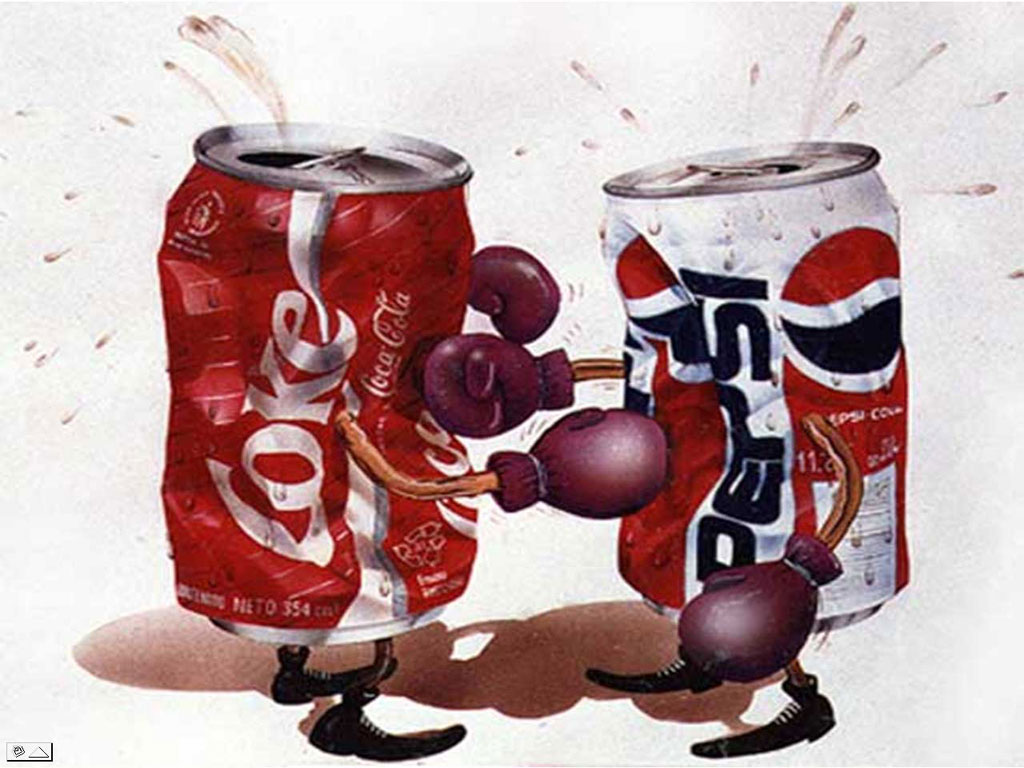
The battle of the beverage behemoths continues. Both are over a century old. Both want your cash. Both have an avid following.
What's the attraction? The fizz, the flavor, the corn syrup? A few years of working in product development for the food industry put me right off corn syrup, so I only drink the diet version. Every sip of Diet Coke is a delight. I am a Coke customer for life. Pepsi in any form is just...yucky.
Coca-Cola is the most recognized brand in the world. Coke brings to mind what is best about the American way of life: first girl-boy parties, dates and shy kisses; war-weary soldiers getting letters from home; a rusted sign creaking in the wind outside the local restaurant. Plus it can be used to relieve the sting from jelly fish and remove rust spots from chrome car bumpers.
It's Coca-Cola Chicken and Coca-Cola Cake in the South for a reason...Pepsi just doesn't cut it. For many, it symbolizes the magic of childhood and kindles the memories of family gatherings, football games and school dances.
For me, Coca-Cola is still the real thing. I now drink water with my Costco hot dog, missing that red and white wave patterned cup overflowing with an abundance of taste.
A circadian rhythm is a roughly 24-hour cycle in the biochemical, physiological, or behavioral processes of living entities, including plants, animals, fungi...practically every living thing on the globe.I tried to interrupt my rhythm today, or yesterday depending on how you look at it. One of our 3rd shift employees recently left and I needed to be at work around 1:00 am to perform some skilled  tasks. I left work early during the day and did my best to tire myself out by digging a 12 inch deep by 15 foot long trench and constructing a 15 foot by 3 foot planter (more on the trench and planter at a later date). Despite feeling tired and a bit achy, it really didn't help me to get to sleep when I headed for bed at 6:00 pm. I drifted in and out of sleep for a while, watched a bit of television and eventually fell asleep sometime after 8:00 pm.I awoke to a ringing telephone and a 30 minute warning. Bed hair not withstanding, I looked and felt okay. I started the test at 2:00 am. Within 30 minutes I was reminded of those "baby daze" when waking up several times during the night for the care and feeding of an infant would render me nauseous and unable to think clearly. Fortunately a large glass of water took care of my malaise and I was up and running at something near full speed.For many, this shift is their normal work time. Waiters, waitresses, cooks, bakers, the voices on the radio, security guards, cleaning services, hospital workers, taxi cab drivers...the list is long. There is a new and growing nocturnal work force lurking in the neon glow. The graveyard or the third-shift, once predominantly populated by blue-collar workers, is now also filling its ranks with energy brokers, computer programmers, and financial advisers. Think of those who answer our phone calls on the other side of the world. Relatively high wages and the opportunity to be part of an upscale, globalized work environment draw many in the Far East to the call center industry.Shift differentials, fewer meetings, less traffic, fewer people to compete with for promotions...there are many good reasons for working the night shift. I prefer to sleep during the night, but that's just me.The balance of the night passed without issue. I completed the testing and eventually headed home. Now at 5:45 am, when I need to be going to sleep, I am very much awake, having arrived at the time of day I typically wake up. I see a power nap or two in my immediate future.
Ask five different people why sounds appear to carry further at night and you'll likely get five different answers. Air temperature, humidity, lack of visual acuity in the dark leads to better hearing capability, air density...the list goes on.
The speed of sound is one of the physical constants we count on. Sound level decreases at a rate proportional to the inverse square of the distance from the sound source. Let's say you're listening to the radio. If you double the distance between you and the radio, the sound will be one-quarter as loud as it was before you moved. Whether or not you could hear it during the day, the sound from your refrigerator was still there. At night it has less to compete with in terms of background noise. Sounds that are drowned out during the day are much clearer at night.
Fewer cars passing by, less airplane traffic, kids no longer playing outside...all these and many more result in a quieter neighborhood. As I was reading in bed the other night, the silence was interrupted three times.
First was the squawking of seagulls as they passed over our house. Barely noticeable to most of our neighbors, seagulls are still a novelty for us. It has been nearly twenty years since we lived in a place with more than a small handful of seagulls, so listening to them is still a treat.
Second was the deep whistle of a train, followed by the low rumble of the engines and dozens of cars. The tracks hug the coastline in this area, reminding me of the many times I rode the Coast Starlight between Davis and Santa Barbara, sleeping and waking over and over as the train started and stopped, looking out into the ever-shifting view of dark skies and clusters of stars.
Third was a lone bagpipe. This was the sound that actually got me out of bed to open the bathroom window and listen closer. The piper serenaded the neighborhood with the sounds of the highlands for about fifteen or so minutes. I wish whomever it was had gone on longer, but it was a wonderful concert despite its brevity. I have yet to find the piper or hear from them again. Fortunately I won't be without live bagpipe music for long, as the 50th Annual Bellingham Scottish Highland Games is coming soon.
 The Scottish Great Highland Bagpipe and Irish uilleann pipes have the greatest international visibility, but bagpipes of many different types come from different regions throughout Europe, Northern Africa, the Persian Gulf, and the area of the Caucasus Mountains. All produce an unusual sound, one that is impossible to ignore.
I can not explain my attraction to the drone and skirl of the bagpipe, as I know they are not for everyone. I may not know why, but I don't question that to me, the pipes, the pipes they are a calling.
Letters are intrinsically dramatic. Were you expecting one? Who is it from? What are they writing about? In this day and age of electronic mail, how often do you get letters?
I received two envelopes earlier this week. Both arrived on the same day. Both were canceled on the same day, albeit it in different cites. And both contained hooey.
That's right, hooey. Babble, balderdash, baloney, drivel, garbage, gibberish, hogwash, horse-feathers, piffle, poppycock, rubbish, tomfoolery. Call it what you will, it was hooey.
One envelope contai ned a money making opportunity that was not a chain letter. The author (unknown, of course) guaranteed it was not in violation of the US Postal Code. In fact, they stated it several times. And had a letter from a lawyer (no name, of course) indicating it is legal. And it was seen on Oprah and 20/20, so it must be true, right?
The second envelope contained a letter from my ex-employer, the mail-order company Harry & David, explaining they would "not rest until we once again feed you, and your soul". It was signed by the new Chairman, CEO and Chief Happiness Officer. Oh puleeze. Perhaps they should try purging their mailing list of all the ex-employees that were laid-off over the last 18 months before sending a form letter that supposedly speaks to your soul.
E-mail, telephones, fast food...so much instant gratification. Letters are planned and organized, hold your attention and provide the uninterrupted privacy so many of us long for. I was ready to respect the time and effort put into both only to have my hopes dashed not once but twice in the same day.
Cindy and I have owned four different houses over the course of the last 21 years. Each was our home for a period of time. I like to think they were better for us living in them, but you'd have to ask the houses about that.
The things we do to our homes are a kind of calling card left behind for those who are still to come. The improvements, the alterations, the color of the walls, the cut of the trim...they all say, “we were here.” There has been one constant in the many calling cards we left for the next inhabitants of the houses we owned: roses.
The rose is almost as old as history itself, with fossil evidence indicating it is over 35 million years old. Across the centuries, roses have been symbols of love, beauty, war and politics. For me, they are a tie to my maternal grandfather. He came to the United States from Italy in 1920 and began working as a gardener, which he did until his death in 1972. As a child, I recall visiting the estate he worked on in Montecito, CA. Filled with trees and plants of every kind, it was the perfect place for a kid to run and play. 
The Rose Garden at Mission Santa Barbara is filled with a myriad color of roses. It is where I first saw David Austin Roses, planted near a stone wall which is a remnant of the Mission era. Introduced in 1969 by hybridizing already existing hybrids with old world species of typically English roses, David Austin built the foundation for an ever expanding collection of roses never seen before. Appealing forms of older species combined with the hardiness of modern hybrids produce a masterpiece of artfully arranged petals.
Who could have predicted one day I would work for Jackson & Perkins, one of the premier rose growing companies in the world? Or that one day David Austin himself would visit J&P in Medford and I would get the opportunity to meet him?
New job, new city, new home, and this house is no exception: there are seven calling cards in the yard, and five of them are from David Austin.
Biblical parables have their mustards, Johnny Appleseed spread his trail over the country, and Jack planted magical beans to find a beanstalk the next morning. We plant roses.